Journal of Eexercise & Organ Cross Talk

Combined resistance training and pineapple extract attenuates oxidative stress and favors hepatic Cox1/Cox2 balance in B16F10 melanoma-bearing mice

Document Type : Original Article

Authors

Department of Physical Education and Sport Sciences, SR.C., Islamic Azad University, Tehran, Iran.

10.22122/jeoct.2026.608150.1234
Abstract
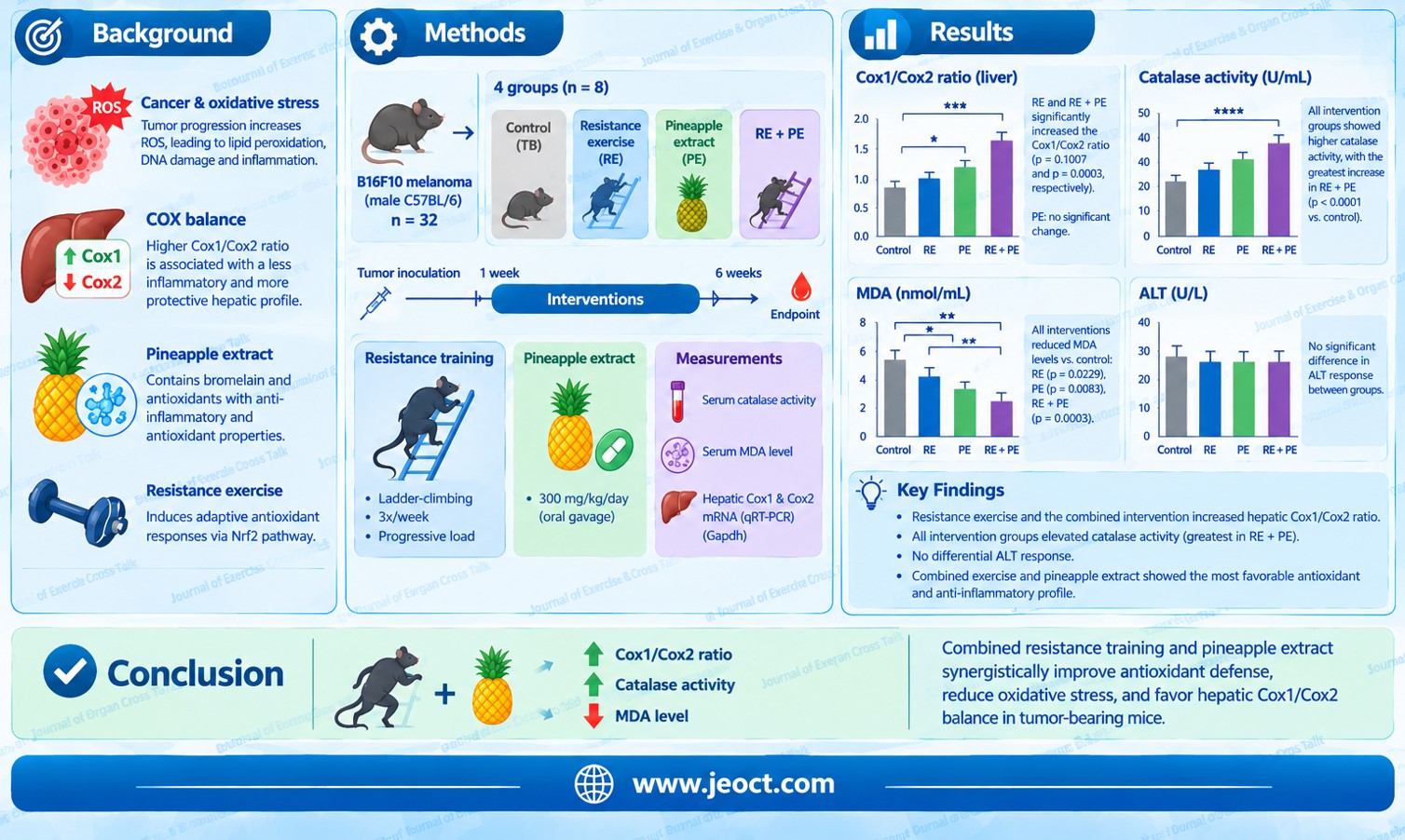
This study evaluated the independent and combined effects of resistance exercise and pineapple extract supplementation on hepatic Cox1/Cox2 expression, serum catalase activity, and lipid peroxidation in B16F10 melanoma-bearing mice. Thirty-two male C57BL/6 mice were inoculated with B16F10 melanoma and randomly assigned to four groups: tumor-bearing control, resistance exercise, pineapple extract (300 mg/kg/day by oral gavage), and resistance exercise plus pineapple extract. Interventions began one week after tumor inoculation and continued for six weeks. Resistance training was performed three times weekly using a progressive ladder-climbing protocol. At the endpoint, serum catalase activity and malondialdehyde (MDA) concentration were measured, and hepatic Cox1 and Cox2 mRNA expression were quantified by quantitative real-time PCR using Gapdh as the reference gene. Both resistance exercise and the combined intervention significantly increased the hepatic Cox1/Cox2 expression ratio compared with the control group (p = 0.0107 and p = 0.0003, respectively), whereas pineapple extract alone did not significantly alter this ratio. Catalase activity was significantly elevated in all intervention groups, with the greatest increase observed after combined exercise and pineapple extract supplementation (p < 0.0001 versus control). Serum MDA concentration was significantly reduced by resistance exercise, pineapple extract, and the combined intervention relative to control (p = 0.0229, p = 0.003, and p = 0.0003, respectively). Resistance exercise, particularly when combined with pineapple extract supplementation, improved systemic antioxidant capacity and reduced lipid peroxidation in tumor-bearing mice. The combined intervention also produced the most favorable shift in hepatic Cox1/Cox2 expression balance, suggesting a potential additive protective effect against tumor-associated oxidative and inflammatory stress.

What is already known on this subject?

Tumor growth is associated with increased production of reactive oxygen species, lipid peroxidation, and chronic low-grade inflammation. Elevated COX-2 expression and prostaglandin E2 signaling contribute to tumor-associated inflammation, angiogenesis, immune suppression, and tumor progression, whereas oxidative stress can further activate inflammatory pathways such as NF-κB.


What this study adds?

This study demonstrates that six weeks of progressive resistance training and pineapple extract supplementation can independently improve systemic antioxidant defense in B16F10 melanoma-bearing mice, as shown by increased serum catalase activity and reduced serum malondialdehyde concentration. The combined intervention produced the greatest increase in catalase activity and the greatest reduction in lipid peroxidation, suggesting an additive protective effect against tumor-associated oxidative stress.

Keywords

Subjects

Organ Cross-Talk Tips:

  • For this study, the most relevant organ crosstalk axis is the tumor–liver–skeletal muscle axis. B16F10 melanoma growth can release tumor-derived cytokines, damage-associated molecular patterns, and circulating inflammatory mediators that alter hepatic metabolism and promote systemic oxidative stress.

Acknowledgements

None.

Funding

None

Data availability

The data supporting the findings of this study are available from the corresponding author upon reasonable request.

Compliance with ethical standards

Conflict of interest the authors declare that there is no conflict of interest in the present research.

Ethical approval All experimental procedures were approved by the Ethics Committee of Islamic Azad University, Tehran, Iran (ethical code: IR.SSRC.REC.1401.058). The study was conducted in accordance with the institutional guidelines for the care and use of laboratory animals and followed the ARRIVE guidelines.

Informed consent 

Not applicable; this was an animal study. 

Consent for publication

Not applicable. 

Author contributions 

Conceptualization: B.T., H.A., M.G. Methodology: B.T., H.A., M.G. Software: B.T. Validation: H.A., M.G. Formal analysis: B.T., H.A. Investigation: B.T. Resources: H.A., M.G. Data curation: B.T. Writing—original draft: B.T. Writing—review and editing: H.A., M.G. Visualization: B.T. Supervision: H.A. Project administration: H.A. Funding acquisition: Not applicable.

Aggarwal, V., Tuli, H. S., Varol, A., Thakral, F., Yerer, M. B., Sak, K., . . . Sethi, G. (2019). Role of reactive oxygen species in cancer progression: molecular mechanisms and recent advancements. Biomolecules, 9(11), 735. doi: https://doi.org/10.3390/biom9110735 
Ali, M. M., Hashim, N., Abd Aziz, S., & Lasekan, O. (2020). Pineapple (Ananas comosus): A comprehensive review of nutritional values, volatile compounds, health benefits, and potential food products. Food research international, 137, 109675. URL: https://www.sciencedirect.com/science/article/abs/pii/S0963996920307006  
Carmo de Carvalho e Martins, M. d., Martins, da Silva Santos Oliveira, A. S., da Silva, L. A. A., Primo, M. G. S., & de Carvalho Lira, V. B. (2022). Biological indicators of oxidative stress [malondialdehyde, catalase, glutathione peroxidase, and superoxide dismutase] and their application in nutrition. In Biomarkers in nutrition (pp. 1-25). Springer. doi: https://doi.org/10.1007/978-3-030-81304-8_49-1  
Coutinho, L. L., Femino, E. L., Gonzalez, A. L., Moffat, R. L., Heinz, W. F., Cheng, R. Y., . . . Wink, D. A. (2024). NOS2 and COX-2 Co-expression promotes cancer progression: a potential target for developing agents to prevent or treat highly aggressive breast cancer. International Journal of Molecular Sciences, 25(11), 6103. doi: https://doi.org/10.3390/ijms25116103  
da Silva Neto, G. J., Leite, T. C. C., Cavalcanti, M. T., Pedrosa, G. T. S., do Nascimento Alves, R., de Sena, A. R., & Gonçalves, M. C. (2026). Bromelain as the enzyme of the future: A global bibliometric mapping of its applications and emerging trends. Journal of the Science of Food and Agriculture. doi: https://doi.org/10.1002/jsfa.70751   
Debnath, R., Majumder, D., Nath, P., Ghosh, D., & Maiti, D. (2020). Bromelain plus peroxidase reduces non-Hodgkin lymphoma progression in invivo via up-regulation of antioxidant enzymes and modulating apoptotic protein expression. Nutrition and cancer, 72(7), 1200-1210. doi: https://doi.org/10.1080/01635581.2019.1670217  
Hashemi Goradel, N., Najafi, M., Salehi, E., Farhood, B., & Mortezaee, K. (2019). Cyclooxygenase‐2 in cancer: a review. Journal of cellular physiology, 234(5), 5683-5699. doi: https://doi.org/10.1002/jcp.27411  
He, F., Li, J., Liu, Z., Chuang, C.-C., Yang, W., & Zuo, L. (2016). Redox mechanism of reactive oxygen species in exercise. Frontiers in physiology, 7, 486. doi: https://doi.org/10.3389/fphys.2016.00486  
Jin, K., Qian, C., Lin, J., & Liu, B. (2023). Cyclooxygenase-2-Prostaglandin E2 pathway: A key player in tumor-associated immune cells. Frontiers in oncology, 13, 1099811. doi: https://doi.org/10.3389/fonc.2023.1099811  
Özdemir, K., & Demir, Y. (2025). Phenolic compounds in exercise physiology: dual role in oxidative stress and recovery adaptation. Food Science & Nutrition, 13(8), e70714. doi: https://doi.org/10.1002/fsn3.70714  
Powers, S. K., Lategan-Potgieter, R., & Goldstein, E. (2024). Exercise-induced Nrf2 activation increases antioxidant defenses in skeletal muscles. Free Radical Biology and Medicine, 224, 470-478. doi: https://doi.org/10.1016/j.freeradbiomed.2024.07.041  
Reljic, D. (2025). High-intensity interval training as redox medicine: targeting oxidative stress and antioxidant adaptations in cardiometabolic disease cohorts. Antioxidants, 14(8), 937. doi: https://doi.org/10.3390/antiox14080937  
Sanlier, N., Irmak, E., & Ankarali, E. (2026). Potential health benefits of bromelain: a critical review of the current literature. Frontiers in Nutrition, 13, 1744666. doi: https://doi.org/10.3389/fnut.2026.1744666  
Seenak, P., Kumphune, S., Malakul, W., Chotima, R., & Nernpermpisooth, N. (2021). Pineapple consumption reduced cardiac oxidative stress and inflammation in high cholesterol diet-fed rats. Nutrition & metabolism, 18(1), 36. doi: https://doi.org/10.1186/s12986-021-00566-z 
Thirupathi, A., Wang, M., Lin, J. K., Fekete, G., István, B., Baker, J. S., & Gu, Y. (2021). Effect of different exercise modalities on oxidative stress: a systematic review. BioMed Research International, 2021(1), 1947928. doi: https://doi.org/10.1155/2021/1947928   
Vargas-Mendoza, N., Morales-González, Á., Madrigal-Santillán, E. O., Madrigal-Bujaidar, E., Álvarez-González, I., García-Melo, L. F., . . . Morales-Gonzalez, J. A. (2019). Antioxidant and adaptative response mediated by Nrf2 during physical exercise. Antioxidants, 8(6), 196. doi: https://doi.org/10.3390/antiox8060196  
Wulandari, N. P. M. A. K., & Linawati, N. M. (2026). Protective roles of bromelain and flavonoids derived from pineapple peel against UV-induced skin cell damage: A systematic review. Journal of Pharmaceutical and Sciences, 771-782. doi: https://doi.org/10.36490/journal-jps.com.v9i1.1487  


Articles in Press, Accepted Manuscript
Available Online from 01 January 2027

  • Receive Date 03 July 2026
  • Revise Date 02 October 2026
  • Accept Date 18 October 2026