Document Type : Letter to the Editor
Authors
1
Assistant Professor of Sports Management, Department of Sports Sciences, Payame Noor University, Tehran, Iran.
2
Department of Physical Education and Sport Science, Fa.C., Islamic Azad University, Fasa, Iran
Abstract
Dear Editor-in-Chief
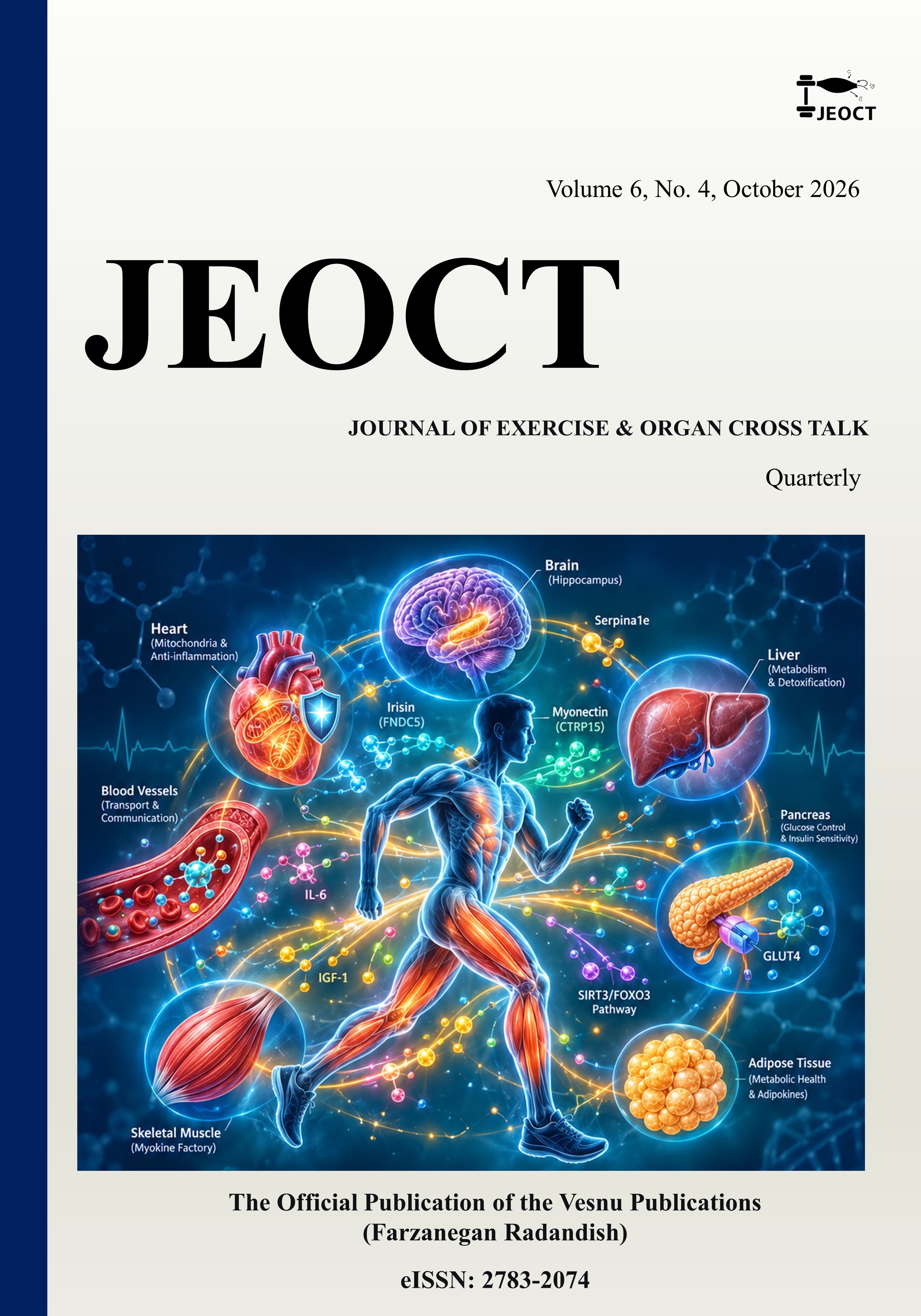
The Journal of Exercise & Organ Cross-Talk has consistently highlighted how skeletal muscle communicates with distal organs through exercise-induced secretory factors. I wish to draw attention to a recently discovered myokine that exemplifies this principle with particular clarity: Serpina1e, a muscle-derived protein that mediates exercise-induced cognitive enhancement through direct action on the hippocampus (Kim et al., 2026). This molecule is proposed here as a candidate of significant future relevance for understanding exercise–organ crosstalk.
Exercise confers well-documented benefits on hippocampal function and memory, yet the molecular intermediaries linking contracting muscle to brain remained incompletely defined. Using an innovative in vivo approach that enables selective biotin-labeling of skeletal muscle–derived proteins, Kim and colleagues identified the Serpina1 family–particularly Serpina1e–as a novel class of exercise-induced myokines (Kim et al., 2026). Unlike its paralogs Serpina1a–d, which function primarily as protease inhibitors, Serpina1e exhibits no such activity, suggesting a distinct signaling role (Forsyth et al., 2003; Jonigk et al., 2013). Following four weeks of exercise, muscle-derived Serpina1e enters the circulation and, critically, crosses both the blood–CSF and blood–brain barriers to reach the hippocampus (Kim et al., 2026). There, it promotes neurogenesis, upregulates BDNF expression, and enhances dendritic complexity and neurite outgrowth in hippocampal neurons (Kim et al., 2026).
The functional evidence is compelling. Systemic administration of recombinant Serpina1e to sedentary mice improved performance in contextual fear conditioning and novel object recognition tests (Kim et al., 2026). Conversely, muscle-specific knockdown of Serpina1e abolished abolished exercise-induced memory enhancement without affecting baseline cognition or exercise performance itself (Kim et al., 2026). These findings position Serpina1e as a necessary and sufficient mediator of exercise’s cognitive benefits–a rare demonstration of causality in exerkine biology.
Particularly relevant to this journal’s scope, Serpina1e appears to operate within a coordinated myokine network rather than as an isolated signal. New evidence indicates that Serpina1e acts upstream of Fndc5/Irisin, regulating its expression in skeletal muscle (Islam et al., 2021). This functional interaction aligns with emerging perspectives that exercise-induced organ crosstalk involves integrated signaling networks defined by secretion kinetics, co-released factors, and target-tissue responsiveness–what has been termed an “endocrine code” (Islam et al., 2021).
Several features make Serpina1e a compelling candidate for future investigation. It represents a muscle-to-brain signaling axis with direct relevance to neurocognitive adaptation, a relatively underexplored dimension of exercise physiology compared to metabolic crosstalk. Its barrier-crossing capacity positions it as a potential therapeutic vehicle or template for delivering neuroprotective signals (Kim et al., 2026). The absence of protease-inhibitory activity in Serpina1e suggests a neomorphic signaling function distinct from the canonical role of its protein family (Forsyth et al., 2003; Jonigk et al., 2013). Finally, the apparent conservation of neuronal growth effects by human SERPINA1 raises translational possibilities (Jonigk et al., 2013).
Key questions remain, including whether Serpina1e effects exhibit sex-specificity (current studies used male mice only), the identity of its receptor or binding partner in the brain, and whether circulating Serpina1e levels correlate with cognitive outcomes in exercising humans (Kim et al., 2026). These gaps define a productive research agenda for the field.
In summary, Serpina1e exemplifies the evolving understanding of skeletal muscle as a source of signals that traverse organ boundaries to shape systemic physiology. Its discovery underscores that the most significant mediators of exercise benefits may not be the most abundant or the most familiar, but those coupling muscle activity to specific target-organ adaptations. The Journal of Exercise & Organ Cross-Talk seems an ideal venue for continued dialogue on this emerging axis.
I hope this letter stimulates discussion among your readership regarding the next frontiers in exercise–organ crosstalk.
Keywords
Subjects